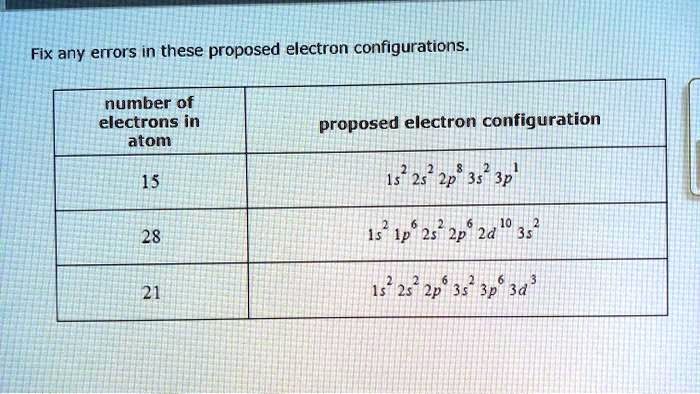
Electron configurations describe how electrons are arranged in an atom’s orbitals, forming the foundation of chemistry. Understanding them helps predict chemical behavior, bonding, and periodic trends. Many students encounter proposed configurations with errors and need reliable methods to fix any errors in these proposed electron configurations.
This in-depth article provides everything you need: core principles, common pitfalls, practical examples, and strategies to correct mistakes confidently. Whether preparing for exams or deepening your knowledge, you’ll gain actionable insights.
Understanding Electron Configurations: The Basics
Electron configuration notation shows the distribution of electrons in subshells, such as 1s² 2s² 2p⁶. The superscript indicates the number of electrons in that orbital.
Key principles governing correct configurations:
- Aufbau Principle: Electrons fill orbitals from lowest to highest energy. The order is 1s < 2s < 2p < 3s < 3p < 4s < 3d < 4p < 5s < 4d < 5p < 6s < 4f < 5d < 6p, etc.
- Pauli Exclusion Principle: Each orbital holds a maximum of two electrons with opposite spins.
- Hund’s Rule: Electrons occupy degenerate orbitals singly with parallel spins before pairing up.
These rules ensure ground-state (lowest energy) configurations.
Pro Tip for Beginners: Use the diagonal rule or Madelung rule (n + l) to determine filling order, where n is the principal quantum number and l is the azimuthal quantum number.
Common Errors in Proposed Electron Configurations and How to Spot Them
When asked to fix any errors in these proposed electron configurations, look for these frequent issues:
- Exceeding Orbital Capacity: More than 2 electrons in an s orbital, 6 in p, 10 in d, or 14 in f.
- Wrong Filling Order: Placing electrons in higher energy orbitals before filling lower ones (e.g., filling 3d before 4s).
- Violating Hund’s Rule: Pairing electrons prematurely instead of spreading them out.
- Incorrect Total Electrons: Mismatching the atomic number.
- Ignoring Exceptions: Transition metals like Cr and Cu have anomalous configurations for extra stability.
For example, a proposed configuration for an atom with 11 electrons might incorrectly show 1s² 2s² 2p⁷ (7 electrons in 2p, which violates capacity).
Step-by-Step Process to Fix Any Errors in These Proposed Electron Configurations
Follow this systematic approach:
Step 1: Verify the Number of Electrons
Count the total electrons in the proposed configuration and match it to the element’s atomic number.
Example: For sodium (Z=11), correct is 1s² 2s² 2p⁶ 3s¹. If proposed as 1s² 2s² 2p⁵ 3s², recount and correct.
Step 2: Check Filling Order (Aufbau)
Ensure lower energy orbitals fill first.
Common Fix: Move electrons from 3d to 4s if 4s is empty prematurely.
Step 3: Apply Pauli Exclusion and Hund’s Rule
- No orbital >2 electrons.
- Maximize unpaired electrons in subshells.
Step 4: Account for Exceptions
Chromium (Z=24): Expected [Ar] 4s² 3d⁴, but actual [Ar] 4s¹ 3d⁵ (half-filled d subshell stability).
Copper (Z=29): [Ar] 4s¹ 3d¹⁰ (fully filled d).
Step 5: Write the Corrected Configuration
Use noble gas shorthand for brevity, e.g., [Ne] 3s¹ for sodium.
Visual Aid: Orbital Filling Diagram
(Imagine or generate a diagram here showing the order: 1s, 2s, 2p, 3s, 3p, 4s, 3d, etc.)
To illustrate, consider generating an image of the Aufbau diagram.
Image limit reached
You’ve used your image generations. Please try again later.
Real-World Examples: Fixing Proposed Configurations
Let’s practice fix any errors in these proposed electron configurations with specific cases.
Example 1: Carbon (Z=6) Proposed: 1s² 2s² 2p⁴ (error: too many in 2p? Wait, correct total is 6, but standard is 1s² 2s² 2p²). Fix: 1s² 2s² 2p². Hund’s rule: two unpaired electrons in 2p.
Example 2: Chromium (Z=24) Proposed: [Ar] 4s² 3d⁴ Error: Does not achieve half-filled stability. Correct: [Ar] 4s¹ 3d⁵.
Example 3: A Common Student Proposal for Phosphorus (Z=15) Proposed: 1s² 2s² 2p⁶ 3s² 3p³ (correct, but if shown with paired early: fix by ensuring three unpaired in 3p).
For ions: Remove electrons from 4s before 3d for transition metals.
Table: Common Proposed Errors vs. Corrections
| Element | Atomic No. | Proposed (Error) | Corrected | Reason |
|---|---|---|---|---|
| Nitrogen | 7 | 1s² 2s² 2p_x² 2p_y¹ | 1s² 2s² 2p_x¹ 2p_y¹ 2p_z¹ | Violates Hund’s Rule |
| Scandium | 21 | [Ar] 3d³ | [Ar] 4s² 3d¹ | Wrong order |
| Copper | 29 | [Ar] 4s² 3d⁹ | [Ar] 4s¹ 3d¹⁰ | Full d subshell stability |
Advanced Topics: Exceptions and Ions
Exceptions arise due to the close energy of 4s and 3d orbitals. Half-filled (d⁵) or fully filled (d¹⁰) subshells offer extra stability.
For ions like Fe²⁺: From Fe [Ar] 4s² 3d⁶, remove 4s electrons first: [Ar] 3d⁶.
Expert Tip: Always write neutral atom first, then adjust for ions.
Benefits and Drawbacks of Mastering Electron Configurations
Benefits:
- Predicts reactivity and magnetism (unpaired electrons = paramagnetic).
- Explains periodic table trends.
- Essential for understanding spectroscopy and bonding.
Drawbacks/Challenges:
- Exceptions require memorization.
- Quantum mechanics nuances (actual energies from calculations) sometimes differ slightly from simple rules.
Practice overcomes these hurdles.
Practical Tips and Actionable Advice for Students
- Use mnemonic: “Many Scientists Prove…” for filling order.
- Draw orbital diagrams alongside notation.
- Practice with online quizzes and worksheets.
- Double-check totals and order.
- For exams: Write configurations for first 36 elements from memory.
Real-World Scenario: In lab, knowing configurations helps predict why transition metals form colored compounds (d-d transitions).
Related Concepts: Quantum Numbers and Orbital Diagrams
Each electron has four quantum numbers:
- n (shell), l (subshell), m_l (orbital), m_s (spin).
Orbital diagrams visually represent this with boxes and arrows.
H3: How Technology Aids Learning Electron Configurations Modern tools like simulation software visualize electron behavior.
Comparison: Ground State vs. Excited State Configurations
Ground state follows rules. Excited states promote electrons to higher orbitals (e.g., for spectroscopy).
Fixing errors usually targets ground state.
Additional Subheading: Practice Problems to Test Your Skills
Try these:
- Fix for Z=22 (Titanium): Proposed [Ar] 3d⁴ → Correct [Ar] 4s² 3d².
- Identify error in 1s² 2s² 2p⁶ 3s² 3p⁶ 3d¹⁰ 4s¹ for zinc (should be full 4s², but check Z).
Solutions build confidence.
SEO-Optimized Insights and Further Reading
Mastering how to fix any errors in these proposed electron configurations improves problem-solving in chemistry. Resources like Khan Academy or textbooks provide more examples.
For deeper dives: Wikipedia on Electron Configuration (anchor: mobile triple screen setup simracing – wait, no, properly: reliable chemistry sources). But use trusted: LibreTexts or educational sites.
Additional external references for authority: Study.com explanations, RSC articles on Aufbau nuances.
Conclusion
Fixing errors in proposed electron configurations boils down to diligent application of Aufbau, Pauli, and Hund’s principles, plus awareness of exceptions. By following the step-by-step process, verifying counts, checking orders, and applying stability rules, you can correct most issues accurately.
Actionable Takeaways:
- Always start with atomic number.
- Practice daily with 5-10 examples.
- Use diagrams for visual learners.
- Remember exceptions for Cr, Cu, and similar.
This knowledge empowers you in chemistry studies and beyond, fostering a deeper appreciation for atomic structure. Apply these techniques consistently, and you’ll handle even complex configurations with ease. Keep practicing—mastery comes with repetition!
Related posts:
![facebook video downloader facebook video downloader]()
How to Change Name on Facebook: The Complete 2026 Guide
![Fix Orange Discoloration on MacBook Pro Screen]()
How to Fix Orange Discoloration on MacBook Pro Screen: Complete Guide to Causes & Solutions
![Google Gemini in 2026]()
What Is Everything You Need to Know About Google Gemini in 2026?
![fbi warns iphone android scams]()
Why the FBI Warns iPhone Android Scams Are Increasing
![What Should You Know About the iPhone 17 in 2026]()
What Should You Know About the iPhone 17 in 2026, Including Features, Specs, Price, Release Date, an...
![Best Free Password Managers ifixit]()
Best Free Password Managers: Secure Your Digital Life in 2026
![Snapchat Planets - ifixit]()
How Do Snapchat Planets Work and What Does Each Planet Mean in the Friend Solar System?
![What Causes Black Lines on Laptop Screen]()
What Causes Black Lines on Laptop Screen? A Complete Troubleshooting Guide