
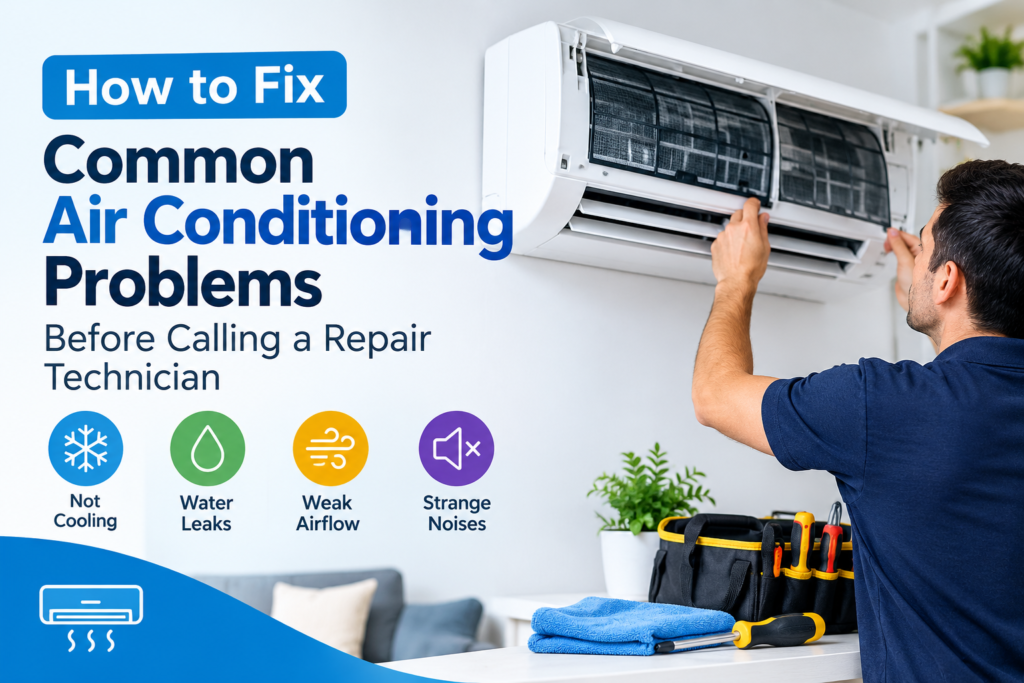
A weak, warm, or completely dead air conditioner during a genuinely hot week feels like an emergency, and the instinct to book the first available repair callout is understandable. But a meaningful share of AC problems trace back to something a homeowner can safely check and often fix themselves in under thirty minutes — before any technician even needs to be scheduled.
Start Here: The Two-Minute Checks That Solve More Than You’d Expect
Before assuming anything is seriously wrong, confirm the basics: the thermostat is actually set to cool (not just “on” or “fan”), the target temperature is genuinely below the current room temperature, and the circuit breaker for the AC hasn’t tripped. According to Carrier’s own troubleshooting guidance, checking thermostat settings and the electrical panel are the first two steps recommended before anything else — and they resolve a genuinely surprising number of “my AC won’t turn on” calls with zero repair needed at all.
Problem 1: The AC Is Running But Not Actually Cooling
This is one of the most common complaints, and it has several possible causes worth checking in order. A dirty air filter is the single most frequent culprit — a clogged filter restricts airflow across the evaporator coil badly enough to noticeably reduce cooling output, and it’s also the easiest thing on this entire list to fix yourself, typically taking under five minutes.
Fixing a Dirty Air Filter
Locate your filter (usually in the return air duct or directly in the indoor unit), slide it out, and hold it up to a light. If you can’t see light passing through clearly, it needs replacing or washing, depending on whether it’s a disposable or reusable type. Most manufacturers recommend checking filters monthly during heavy use and replacing disposable filters every one to three months — a habit that prevents this specific problem from recurring.
Problem 2: The AC Is Blowing Warm or Room-Temperature Air
If a clean filter doesn’t solve warm-air blowing, the next most common causes are a dirty evaporator coil, low refrigerant, or an issue with the outdoor condenser unit. According to Angi’s detailed troubleshooting breakdown, lowering your thermostat by roughly five degrees and watching whether the air actually cools down is a useful first diagnostic step — if it does, your system may simply be struggling against extreme outdoor heat rather than facing an actual fault.
Checking Your Outdoor Condenser Unit
The outdoor unit needs clear airflow to release heat effectively, and something as simple as leaves, grass clippings, or overgrown plants sitting within two feet of it can measurably reduce cooling performance. Turn off the unit at the breaker first, then clear away visible debris by hand and gently rinse the exterior fins with a garden hose from the inside out — never use a pressure washer, since the fins bend and damage easily under high pressure.
Problem 3: Ice or Frost Visible on the Unit
Seeing ice on the copper refrigerant lines or the indoor coil is a genuine warning sign, but it’s also a case where the right first move is simply turning the system off — not troubleshooting further yourself. A frozen coil almost always points to either restricted airflow (a dirty filter, closed vents, or a failing blower fan) or low refrigerant, and running the system while frozen risks damaging the compressor, which is one of the single most expensive components to replace in the entire unit.
How to Safely Handle a Frozen Coil
Switch the thermostat to “off,” not just to a warmer temperature, and let the system sit for two to three hours to fully thaw — running the fan-only mode during this period can speed up the thawing process. Once thawed, check and replace the air filter, confirm all vents around the house are open and unobstructed, and only then try running the system again. If it freezes a second time, that’s a genuine signal to call a professional, since it likely points to a refrigerant leak that requires specialized equipment and certification to diagnose and repair safely.
Problem 4: Water Leaking Around the Indoor Unit
Air conditioners naturally remove moisture from indoor air, and a small amount of condensation is completely normal — but visible water pooling or dripping inside the home usually means the condensate drain line is clogged. According to guidance on diagnosing AC drainage issues, algae, dirt, and general debris buildup inside the drain line is the most common cause, and it’s a genuinely fixable DIY task for most homeowners.
Clearing a Clogged Condensate Drain Line
Locate the drain line — typically a PVC pipe running from the indoor unit to an exterior drain point — and check for visible cracks or an obvious blockage near the access point. A mixture of water and ordinary white vinegar poured through the line’s access point, using a wet/dry vacuum on the outside end to help pull the clog through, clears the majority of routine algae and debris blockages. Dry the pipe thoroughly with a clean cloth afterward, and repeat this maintenance every few months during heavy cooling season to prevent recurrence.
Problem 5: The AC Won’t Turn On At All
Beyond the thermostat and breaker checks covered earlier, confirm the thermostat’s batteries aren’t dead if it’s battery-powered, and check whether the outdoor unit’s own dedicated disconnect switch (often a small grey box mounted near the unit itself) has been accidentally switched off. These three checks together resolve a genuinely large share of “completely dead” AC complaints without needing any tools or technical knowledge.
Problem 6: Strange or Concerning Noises
Not all AC noises mean the same thing, and knowing the difference helps you decide whether to keep troubleshooting or shut the system down immediately. A rattling or clicking sound can sometimes mean loose debris in the outdoor unit, worth a quick visual check once the power is off. Grinding, banging, or squealing noises, however, typically indicate a genuinely failing component — a worn motor bearing, a loose fan blade, or a failing belt — and these specific noises are a clear signal to power down and call a professional rather than attempt a fix yourself.
Problem 7: The AC Turns On and Off Too Frequently
This pattern, sometimes called short cycling, increases both energy consumption and long-term wear on the compressor. Common, fixable causes include a thermostat located near a heat source (direct sunlight, a lamp, a kitchen appliance) that’s giving the system inaccurate temperature readings, or a genuinely oversized unit for the space it’s cooling. Relocating a poorly-placed thermostat is a simple DIY fix; an oversized unit generally requires a professional assessment rather than a homeowner fix.
What You Should Never Attempt Yourself
Refrigerant handling absolutely requires a licensed, certified technician — it’s both a genuine safety issue and, in most jurisdictions, a legal requirement, not just a recommendation. Electrical component repairs (a failing capacitor, damaged wiring, or a malfunctioning compressor) also fall firmly into professional-only territory. According to American Standard’s guidance on common AC repairs, a failing capacitor specifically often shows warning signs — humming without starting, visible bulging on the capacitor itself, or the system struggling to turn on — and the correct homeowner response is to power down and call for repair, not attempt a replacement.
Building a Simple Prevention Routine
Most of the problems covered above become far less frequent with a basic seasonal maintenance routine: checking and replacing filters monthly during heavy use, clearing debris from around the outdoor unit regularly, and flushing the condensate drain line every few months. Readers managing [CLIENT LINK PLACEHOLDER] home maintenance schedules across multiple appliances often find that adding AC filter checks to an existing monthly routine — alongside other recurring tasks — prevents most of these issues from ever reaching the point of needing a repair callout at all.
When Professional Maintenance Is Worth Scheduling Proactively
Beyond reactive troubleshooting, most HVAC manufacturers and technicians recommend a professional maintenance visit once a year, ideally scheduled before cooling season begins rather than during the first genuinely hot week. This visit typically checks refrigerant levels, tests electrical components, and inspects parts that aren’t practical or safe for a homeowner to assess alone — catching small issues before they become the kind of mid-summer emergency that costs considerably more to fix under pressure.
Repair vs. Replace: A Quick Way to Think About It
If your system is more than 10-12 years old, has needed frequent repairs in the past year or two, or a single repair quote approaches a meaningful fraction of what a new unit would cost, it’s worth getting a second opinion on repair-versus-replace rather than defaulting to another repair. This mirrors the same cost-benefit thinking we’ve covered in how to decide between DIY repair and professional service for a cracked phone screen — the right call depends on the specific numbers in front of you, not a general rule that repair is always cheaper.
Why AC Problems Cluster During Extreme Heat Specifically
It’s not a coincidence that AC failures spike during the hottest days of the year — a system already working at or near its maximum capacity has far less margin to compensate for a partially clogged filter or a slightly low refrigerant charge than it would on a mild day. This is exactly why proactive maintenance timed before peak season, rather than reactive troubleshooting during a heatwave, produces meaningfully fewer emergency situations.
Understanding What Each Part of Your System Actually Does
A basic mental model helps make troubleshooting less intimidating: the indoor evaporator coil absorbs heat from your home’s air, the refrigerant carries that heat outside, and the outdoor condenser releases it into the outdoor air before the cooled refrigerant cycles back inside. Airflow problems (a dirty filter, blocked vents, debris around the outdoor unit) interfere with this cycle at different points, which is why so many seemingly different symptoms — warm air, ice buildup, water leaks — often trace back to the same root airflow issue.
A Realistic Troubleshooting Order to Follow
When your AC first acts up, work through checks in this order: thermostat settings and batteries, circuit breaker, air filter condition, visible ice on the coil or lines, debris around the outdoor unit, and finally the condensate drain line. This sequence moves from the fastest, safest checks to the ones requiring slightly more effort, and it resolves the large majority of common AC complaints without ever needing a single tool beyond a garden hose and a vacuum.
Frequently Asked Questions
Is it safe to keep running my AC if I see ice on it?
No — turn the system off immediately if you see ice on the coil or refrigerant lines. Continuing to run a frozen system risks damaging the compressor, one of the most expensive components to replace in the entire unit.
How often should I really be changing my air filter?
Checking monthly during heavy use and replacing disposable filters every one to three months is the general guidance most manufacturers recommend, though homes with pets or higher dust levels may need more frequent changes.
Can I add refrigerant to my AC myself if it’s low?
No — refrigerant handling requires specialized equipment and, in most places, a professional certification. Attempting this yourself is both a safety risk and, in most jurisdictions, not legally permitted for homeowners.
My AC is making a clicking noise — is that normal?
Occasional clicking, particularly when the system starts or stops, is often normal relay operation. Constant or worsening clicking, however, can indicate a failing thermostat or relay switch and is worth having checked if it persists.
The Bottom Line
A genuinely large share of air conditioning complaints — dirty filters, debris-blocked outdoor units, clogged drain lines, simple thermostat or breaker issues — are safe, fixable checks any homeowner can run through in under half an hour, no tools or technical background required. Knowing where that DIY line actually ends, and calling a professional promptly for refrigerant, electrical, or persistent freezing issues, is what keeps a manageable problem from becoming a much more expensive one.